The Byzantine Empire and Emerging Europe Guided Reading Activity
History of the Byzantine Empire (Byzantium)
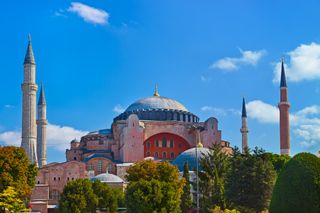
The Byzantine Empire, also called Byzantium, was the eastern one-half of the Roman Empire, based at Constantinople (modernistic-day Istanbul) that continued on after the western one-half of the empire complanate.
Byzantium continued on for virtually a millennium until Constantinople itself cruel in a siege carried out by the Ottoman Empire in 1453. The gilt historic period of the empire came during the reign of Justinian (A.D. 527-565) during which the empire's territories extended as far as Western Europe, and the emperor's builders constructed the Hagia Sophia, a bully cathedral that however stands today.
Throughout their history, the people of Byzantium connected to refer to themselves every bit "Romans" writes Timothy Gregory, a professor at Ohio Country Academy, in his volume "A History of Byzantium" (Wiley-Blackwell, 2010).
They referred to themselves as Romans even though the Byzantines rarely controlled Rome, and spoke mainly Greek. In A.D. 1204, during the Crusades, they were betrayed when crusaders from the w sacked Constantinople in an attempt to gain money.
Origins
Constantine I took command of the Roman Empire subsequently winning the Battle of the Milvian Bridge in October of A.D. 312. The events earlier the battle are steeped in legend, but Constantine is said to have had some sort of religious experience that resulted in his warming to Christianity. Gregory notes that he was baptized before long before his death in A.D. 337.
Gregory notes that Constantine brought in a number of important changes that laid the foundations for the Byzantine Empire.
"The most significant of these changes were the emergence of Christianity every bit the favored (and then the official) faith of the state and the cosmos of Constantinople as the new urban center of the empire on the shores of the Bosphorus, midway between all the empire'southward frontiers," he writes.
Constantinople was built on the site of Byzantium, an urban centre that had a long history of prior occupation. The writer Sozomen, who lived in the fifth century A.D., claimed that Constantine's choice of location for his new metropolis was inspired by God.
Constantine's death led to a series of short-lived successors. Theodosius I, who died in A.D. 395, was the last sole Roman emperor. Subsequently his expiry, the empire was split in 2, the western half collapsing within a century but the eastern one-half living on and thriving, becoming what nosotros call Byzantium.
Justinian I
Justinian I became emperor in 527. While information technology is said that the golden age of Byzantium occurred during his reign Justinian's dominion certainly did non starting time off every bit golden. He came to power considering he was the nephew, and adopted son, of his uncle, Justin I, a palace soldier who had usurped the throne.
In 532, just five years into his rule, Constantinople was hit by the Nika riots (Nika means "victory" or "conquer"). The aboriginal wrier Procopius (who lived in the sixth century A.D.) wrote that Constantinople, along with other imperial cities, was split into two factions called the "blueish" and the "green," which tended to have out their rivalry at the racetrack.
Byzantine government arrested members of the factions and sentenced them to be executed. That's when the riot bankrupt out; the rioters were angry with Justinian for the arrests, as well equally the high taxes he imposed, and tried to overthrow him.
The "members of the two factions conspiring together and declaring a truce with each other, seized the prisoners and and so straightway entered the prison and released all those who were in confinement there … Fire was applied to the city as if it had fallen nether the manus of an enemy …" wrote Procopius.
(From History of the Wars, I, xxiv, translated by H.B. Dewing, Macmillan, 1914 through Fordham University Website)
Justinian had to call in troops to put down the rioters, only he took advantage of the situation to build something yard. At the site of a destroyed church called the Hagia Sophia ("Holy Wisdom") he would have a new, far grander, cathedral congenital.
"Hagia Sophia's dimensions are formidable for any structure not built of steel," writes Helen Gardner and Fred Kleiner in their book "Gardner's Art Through the Ages: A Global History." "In plan it is near 270 feet (82 meters) long and 240 feet (73 meters) wide. The dome is 108 feet (33 meters) in diameter and its crown rises some 180 feet (55 meters) above the pavement."
Afterward it was built, Justinian is said to have remarked "Solomon, I have outdone thee."
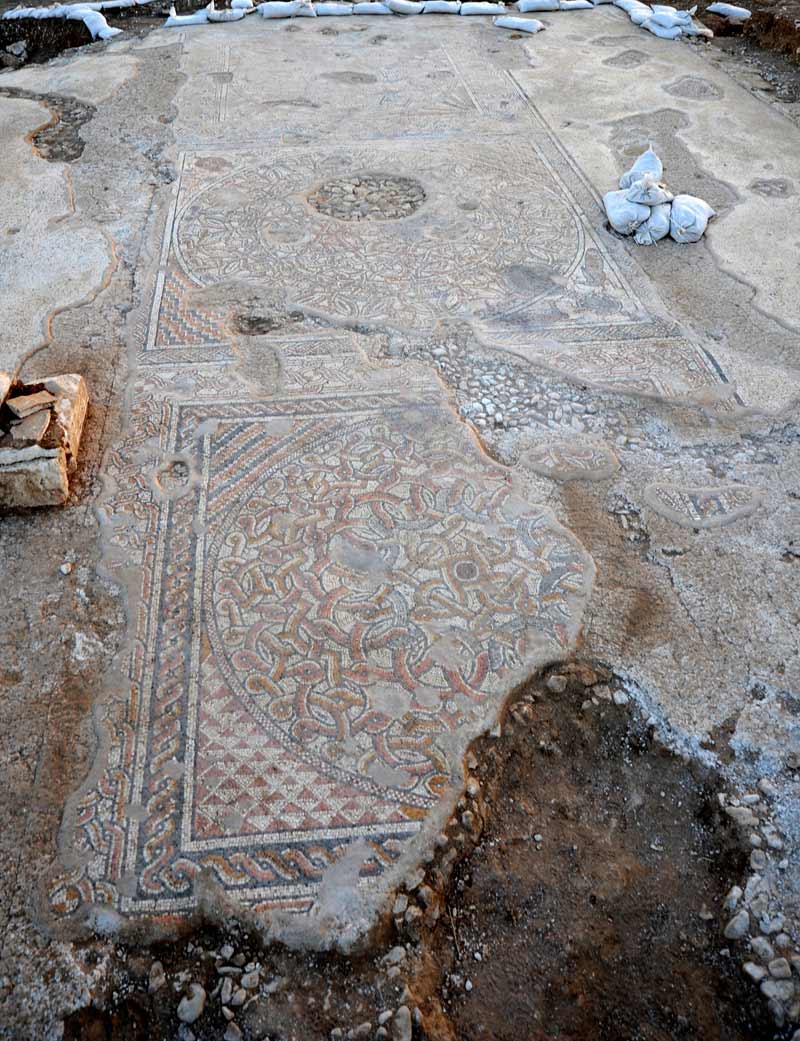
In addition to building an incredible cathedral, Justinian oversaw a major territorial expansion of the empire, winning back territory in North Africa, Italy (including Rome), and parts of Western Europe. [Related: Stunning Byzantine Mosaic Uncovered in Israel]
The intellectual achievements of Justinian'due south reign were as well great and deport on to nowadays 24-hour interval. "Art and literature flourished under his rule, and his officials carried out a remarkably thorough synthesis of Roman law that has served as the basis of the legal systems of much of Europe up to the nowadays day," writes Gregory.
In AD 541/542 a plague tore into Justinian'south empire, inflicting the emperor himself, although he survived. However, "many of his compatriots did not, and some scholars have argued that as much as ane-3rd the population of Constantinople perished," writes Gregory, noting that the disease would re-occur roughly every 15 years into the seventh century.
The spread and impact of the plague may have been aided past a nutrient shortage brought most past cooler conditions conditions. Recent research suggests that the passing of Halley'south comet in A.D. 536 blanketed the Globe, resulting in lower temperatures. Information technology has also been suggested that a volcanic eruption in El Salvador contributed to the cooler weather.
The Byzantine Dark Age
The centuries afterwards Justinian'due south death are sometimes referred to as the Byzantine "Dark Age" and for good reason, as a serial of misfortunes befell the empire.
In the west, much of the territory that Justinian had captured was lost. By the beginning of the seventh century, "much of Italy was nether Lombard rule, Gaul was in Frankish hands and the coastal regions of Espana, the final acquisition of Justinian's re-conquest, were soon to autumn to the Visigoths," writes Andrew Louth, a professor at Durham Academy, in a chapter of the book "The Cambridge History of the Byzantine Empire" (Cambridge University Printing, 2008).
He also notes that between 630 and 660 much of the empire's eastern territory (including Egypt) would be lost to the Arabs. This put the empire in a bad spot.
"This radical upheaval, together with the persistent aggression of the Arabs confronting the remaining Byzantine lands and the incursions of Slavs and peoples hailing from the central European steppe into the Balkans, accelerated the transition of the cities of the eastern Mediterranean earth that was already well underway," writes Louth.
"By the end of the (seventh) century the cities had lost much of their social and cultural significance and survived as fortified enclaves," used as well for markets he writes. "Even Constantinople barely survived, and did so in much reduced circumstances."
These difficult times perchance contributed to iconoclasms that occurred in the eighth and ninth centuries A.D. During these periods, much Byzantine religious artwork was destroyed in fear that they were heretical.
Byzantine comeback?
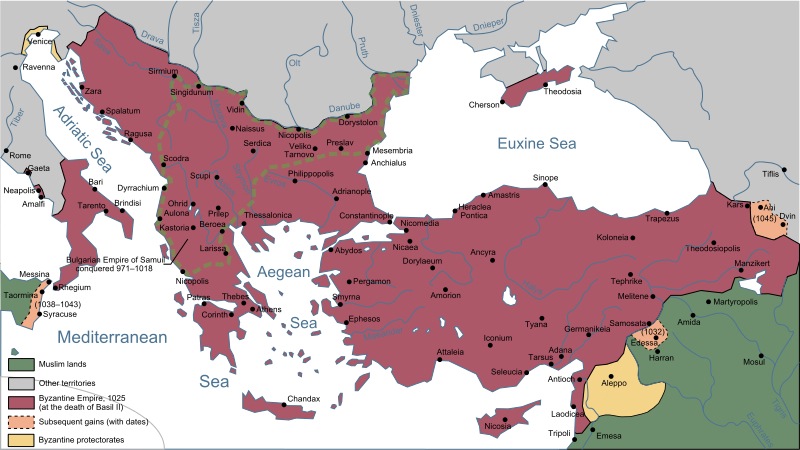
Byzantium never returned to the "gilt age" it had reached during Justinian'due south rule. Yet, the war machine situation stabilized in the ninth century and by the 11th century, Byzantium had gained back a considerable corporeality of territory that it had lost.
Past the time of the decease of Emperor Basil 2 in December 1025, later on a reign of most 50 years, Byzantium was "the dominant power of the Balkans and Heart E, with patently secure frontiers along the Danube, in the Armenian highlands and beyond the Euphrates," writes Michael Angold, a professor at the University of Edinburgh, in a separate chapter of "The Cambridge History of the Byzantine Empire." Additionally, they had succeeded in spreading Christianity to the due north.
Angold notes that this comeback, of sorts, was tenuous to say the to the lowest degree. "Fifty years later, Byzantium was struggling for its existence. All its frontiers were breached," he writes. By this fourth dimension, nomads were inbound Turkey and the Danube provinces, while the Normans had seized its Italian territories.
Nevertheless, the empire would regain some semblance of stability and continue on until it was hit with another blow in 1204.
The 4th Crusade
A pivotal moment in the history of the Byzantine Empire occurred in 1204, when an ground forces of crusaders from the west sacked Constantinople and installed a short-lived line of rulers to rule it. The thought of Christians crusading against other Christians was strange fifty-fifty by the standards of the Heart Ages.
There are a number of reasons why it came to this. An important reason is that in the decades preceding the sacking, the Byzantines had become estranged from their former allies in the westward. The Orthodox Church building broke away from the church in Rome in 1054 and, perhaps most importantly, people from the westward were massacred in Constantinople in 1182, partly in response to the growing influence of western merchants and kingdoms.
This meant that in 1203, when a group of cash strapped crusaders were looking for money to finance an expedition to Arab republic of egypt, they were willing to hear out Prince Alexius Angelos, a claimant to the Byzantine throne, who encouraged them to journey to Constantinople before going to Egypt.
If "they helped to reinstate him in Constantinople he would pay them 200,000 marks, give them all the supplies they needed and provide an regular army of x,000 men. He would likewise place the Greek Orthodox Church under the authorization of the papacy," writes Jonathan Phillips, a professor at the Academy of London, in an article in History Today.
Phillips notes that by this time, the Byzantine military was in bad shape. "The decease of Emperor Manuel Comnenus (1143-80) presaged a series of regencies, usurpations and coups. Between 1180 and 1204 no fewer than fifty-8 rebellions or uprisings took place across the empire."
When the crusaders succeeded in taking the city in 1204, they sacked it and put a new line of "Latin" kings from the west on its throne. These rulers would remain in place until a Greek full general named Michael Palaeologus re-took Constantinople and crowned himself Michael VIII (reign 1259-1282).
The end of the Byzantine Empire
While Constantinople was one time again nether control of a Greek ruler, its end was cartoon near. The empire struggled on into the 15th century, the emperors gradually losing their importance in favor of religious officials.
In 1395, Patriarch Anthony actually had to give a voice communication explaining why the Byzantine emperor was still of import.
"The holy emperor has a cracking place in the church, for he is not like other rulers or governors of other regions. This is then because from the beginning the emperors established and confirmed the [true] religion in all the inhabited world…" it read in part.
(From the book Byzantium: Church Society, and Civilization Seen through Contemporary Eyes, Academy of Chicago Printing, 1984, through Fordham University website)
In 1453, after a siege, the growing Ottoman Empire took Constantinople, putting an end to the empire. When the Ottomans examined the Hagia Sophia, which had been built well-nigh one,000 years before, they were amazed.
"What a dome, that vies in rank with the nine spheres of sky! In this work a perfect master has displayed the whole of the architectural science," wrote Ottoman historian Tursun Beg (from a 2005 British Archaeological Reports series volume by Elisabeth Piltz). They turned the Hagia Sophia into a mosque, calculation four minarets that ascension more than than 200 feet (60 meters) off the footing.
Today, although the Byzantine Empire is long gone, the city of Constantinople (now chosen Istanbul) flourishes and is even so regarded as a crossroads, both literally and metaphorically, between Europe and Asia.
— Owen Jarus

Owen Jarus writes almost archaeology and all things about humans' past for Live Science. Owen has a bachelor of arts degree from the Academy of Toronto and a journalism degree from Ryerson University. He enjoys reading about new research and is always looking for a new historical tale.
Source: https://www.livescience.com/42158-history-of-the-byzantine-empire.html

Post a Comment for "The Byzantine Empire and Emerging Europe Guided Reading Activity"